
How Does a Catalytic Converter Work?
Understanding how a catalytic converter works requires looking at the intersection of chemistry, materials science, and automotive engineering. At its core, a catalytic converter uses precious metals to trigger chemical reactions that neutralize toxic exhaust gases — but the engineering behind this process is remarkably sophisticated.
The Honeycomb Substrate
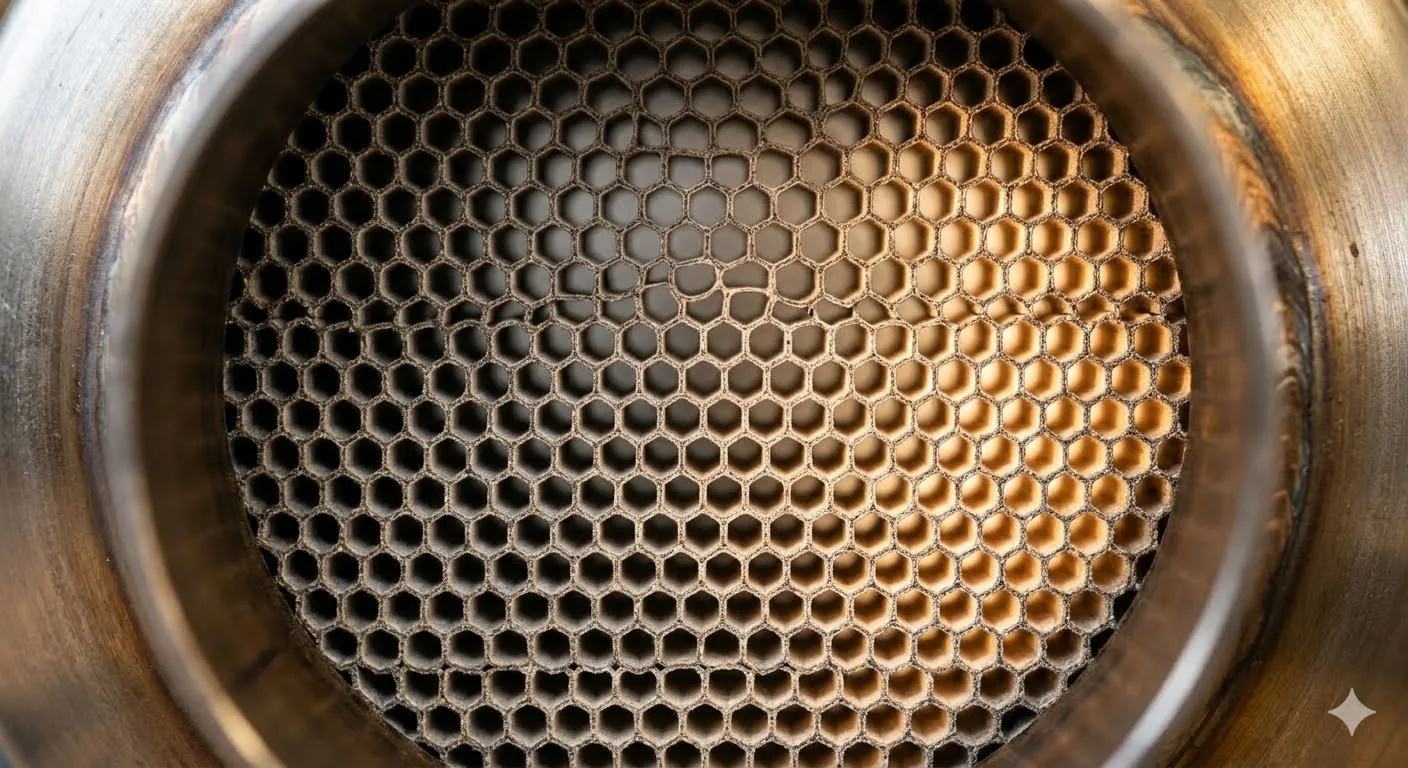
Inside every catalytic converter is a honeycomb structure (called the substrate) made of ceramic (cordierite) or metallic (stainless steel foil) material. This honeycomb contains thousands of tiny channels — typically 400-900 cells per square inch. The enormous surface area (equivalent to roughly 2 football fields in a single converter) maximizes contact between exhaust gases and the catalyst material coated on its surface.
The Washcoat and Precious Metals
The substrate is coated with a washcoat — a thin layer of aluminum oxide (alumina) that creates a rough, porous surface. Embedded in this washcoat are microscopic particles of precious metals: platinum (Pt) for oxidation reactions, palladium (Pd) for oxidation reactions, and rhodium (Rh) for reduction reactions. A typical converter contains 3-7 grams of these metals combined, worth $100-500 at current market prices.
The Chemical Reactions
When hot exhaust gases (400-600°F minimum) flow over the catalyst-coated substrate, three reactions happen simultaneously. The reduction catalyst (platinum + rhodium) strips oxygen atoms from nitrogen oxide molecules, releasing harmless nitrogen and oxygen. The oxidation catalyst (platinum + palladium) forces carbon monoxide to bond with oxygen, creating carbon dioxide, and burns off unburned hydrocarbons into CO₂ and water vapor.
Why They're So Expensive
The cost comes from the precious metals. Rhodium alone trades at $4,500-5,000 per ounce, making it more valuable than gold. Palladium trades at $900-1,200/oz, and platinum at $900-1,100/oz. Even the small amounts in each converter represent significant material costs, which is also why catalytic converter theft has become epidemic.